Home
Destinations
Destinations
Our expeditions go beyond checklists and photo ops.
We collaborate with field biologists, local communities, and conservationists to offer travel that’s immersive, ethical, and unforgettable.
This isn’t about seeing more. It’s about feeling
more — and leaving with stories worth retelling.
Our expeditions go beyond checklists and photo ops. We collaborate with field biologists, local communities, and conservationists to offer travel that’s immersive, ethical, and unforgettable.
This isn’t about seeing more. It’s about feeling more — and leaving with stories worth retelling.
Explore our adventures
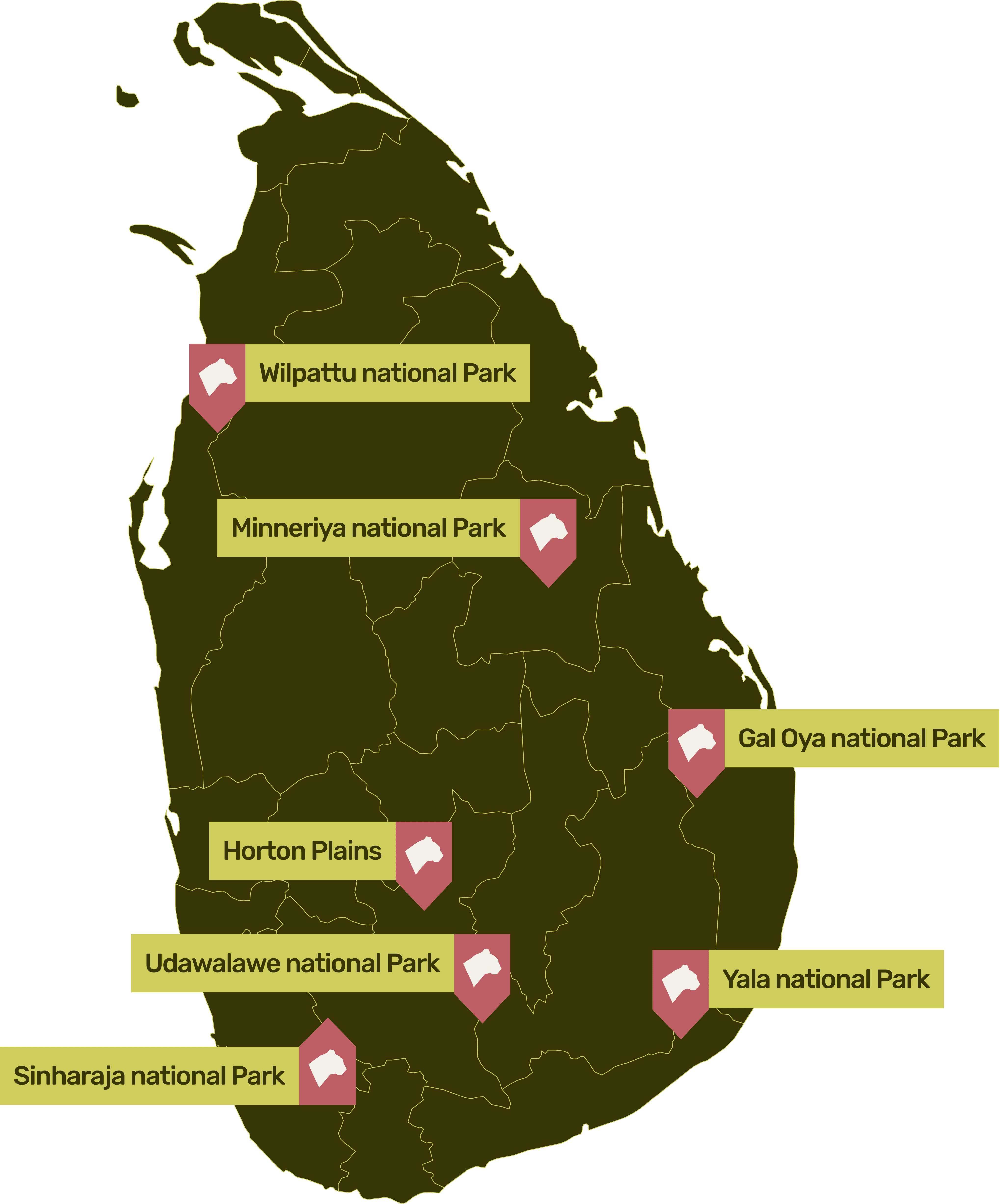
Sri Lanka’s Wildlife Destinations:
| Explore, Learn, Connect
Sri Lanka’s Wildlife Destinations:
| Explore, Learn, Connect
Unlock the natural wonders of Sri Lanka through carefully curated wildlife destinations. Each location below pairs with our tours, offering immersive experiences within the island’s most iconic ecosystems, from leopard-rich jungles to highland cloud forests and coastal marine havens.
Unlock the natural wonders of Sri Lanka through carefully curated wildlife destinations. Each location below pairs with our tours, offering immersive experiences within the island’s most iconic ecosystems, from leopard-rich jungles to highland cloud forests and coastal marine havens.
Tissamaharama, sri lanka
Yala National Park
| The Land of Leopards
Overview:
Sri Lanka's most visited national park, spanning 979 square kilometres of dry forest, grassland, wetland, and coastal lagoon along the southeastern coast. Its Block 1 alone is thought to hold as many as 90 resident leopards, alongside 44 mammal species and 215 recorded bird species.
Why It Matters
Yala holds the highest leopard density recorded anywhere on Earth, made possible by the absence of tigers or lions, which has left the Sri Lankan leopard as the island's undisputed apex predator. Sloth bears, elephants, crocodiles, and six endemic bird species all share this ground.
Tissamaharama, sri lanka
Yala National Park
| The Land of Leopards
Overview:
Sri Lanka's most visited national park, spanning 979 square kilometres of dry forest, grassland, wetland, and coastal lagoon along the southeastern coast. Its Block 1 alone is thought to hold as many as 90 resident leopards, alongside 44 mammal species and 215 recorded bird species.
Why It Matters
Yala holds the highest leopard density recorded anywhere on Earth, made possible by the absence of tigers or lions, which has left the Sri Lankan leopard as the island's undisputed apex predator. Sloth bears, elephants, crocodiles, and six endemic bird species all share this ground.
Tissamaharama, sri lanka
Yala National Park
| The Land of Leopards
Overview:
Sri Lanka's most visited national park, spanning 979 square kilometres of dry forest, grassland, wetland, and coastal lagoon along the southeastern coast. Its Block 1 alone is thought to hold as many as 90 resident leopards, alongside 44 mammal species and 215 recorded bird species.
Why It Matters
Yala holds the highest leopard density recorded anywhere on Earth, made possible by the absence of tigers or lions, which has left the Sri Lankan leopard as the island's undisputed apex predator. Sloth bears, elephants, crocodiles, and six endemic bird species all share this ground.
Tissamaharama, sri lanka
Yala National Park
| The Land of Leopards
Overview:
Sri Lanka's most visited national park, spanning 979 square kilometres of dry forest, grassland, wetland, and coastal lagoon along the southeastern coast. Its Block 1 alone is thought to hold as many as 90 resident leopards, alongside 44 mammal species and 215 recorded bird species.
Why It Matters
Yala holds the highest leopard density recorded anywhere on Earth, made possible by the absence of tigers or lions, which has left the Sri Lankan leopard as the island's undisputed apex predator. Sloth bears, elephants, crocodiles, and six endemic bird species all share this ground.

Puttalam, sri lanka
Wilpattu National Park
| Sri Lanka's Wildest Frontier
Overview:
Sri Lanka's largest and oldest national park, covering 1,317 square kilometres of dry-zone forest around more than 60 natural rain-fed lakes known as villus. Declared a sanctuary in 1905, it predates Yala by decades and offers a far quieter, more spread-out safari.
Why It Matters
Wilpattu ranks among Sri Lanka's premier leopard habitats, alongside sloth bears and elephants, and its remoteness means sightings here feel genuinely earned rather than staged for a queue of jeeps.
Puttalam, sri lanka
Wilpattu National Park
| Sri Lanka's Wildest Frontier
Overview:
Sri Lanka's largest and oldest national park, covering 1,317 square kilometres of dry-zone forest around more than 60 natural rain-fed lakes known as villus. Declared a sanctuary in 1905, it predates Yala by decades and offers a far quieter, more spread-out safari.
Why It Matters
Wilpattu ranks among Sri Lanka's premier leopard habitats, alongside sloth bears and elephants, and its remoteness means sightings here feel genuinely earned rather than staged for a queue of jeeps.
Puttalam, sri lanka
Wilpattu National Park
| Sri Lanka's Wildest Frontier
Overview:
Sri Lanka's largest and oldest national park, covering 1,317 square kilometres of dry-zone forest around more than 60 natural rain-fed lakes known as villus. Declared a sanctuary in 1905, it predates Yala by decades and offers a far quieter, more spread-out safari.
Why It Matters
Wilpattu ranks among Sri Lanka's premier leopard habitats, alongside sloth bears and elephants, and its remoteness means sightings here feel genuinely earned rather than staged for a queue of jeeps.
Puttalam, sri lanka
Wilpattu National Park
| Sri Lanka's Wildest Frontier
Overview:
Sri Lanka's largest and oldest national park, covering 1,317 square kilometres of dry-zone forest around more than 60 natural rain-fed lakes known as villus. Declared a sanctuary in 1905, it predates Yala by decades and offers a far quieter, more spread-out safari.
Why It Matters
Wilpattu ranks among Sri Lanka's premier leopard habitats, alongside sloth bears and elephants, and its remoteness means sightings here feel genuinely earned rather than staged for a queue of jeeps.

Udawalawe, sri lanka
Udawalawe National Park
| Where the Elephants Gather
Overview:
Established in 1972 to protect the catchment of the Udawalawe Reservoir, this 30,800-hectare park of open grassland and scrub is built around a man-made lake that draws elephants to its shores year-round.
Why It Matters
Home to a resident population of roughly 600 wild elephants, Udawalawe offers some of the most reliable sightings anywhere in Asia, and its Elephant Transit Home has hand-reared and released over 150 orphaned calves back into the wild since 1995.
Udawalawe, sri lanka
Udawalawe National Park
| Where the Elephants Gather
Overview:
Established in 1972 to protect the catchment of the Udawalawe Reservoir, this 30,800-hectare park of open grassland and scrub is built around a man-made lake that draws elephants to its shores year-round.
Why It Matters
Home to a resident population of roughly 600 wild elephants, Udawalawe offers some of the most reliable sightings anywhere in Asia, and its Elephant Transit Home has hand-reared and released over 150 orphaned calves back into the wild since 1995.
Udawalawe, sri lanka
Udawalawe National Park
| Where the Elephants Gather
Overview:
Established in 1972 to protect the catchment of the Udawalawe Reservoir, this 30,800-hectare park of open grassland and scrub is built around a man-made lake that draws elephants to its shores year-round.
Why It Matters
Home to a resident population of roughly 600 wild elephants, Udawalawe offers some of the most reliable sightings anywhere in Asia, and its Elephant Transit Home has hand-reared and released over 150 orphaned calves back into the wild since 1995.
Udawalawe, sri lanka
Udawalawe National Park
| Where the Elephants Gather
Overview:
Established in 1972 to protect the catchment of the Udawalawe Reservoir, this 30,800-hectare park of open grassland and scrub is built around a man-made lake that draws elephants to its shores year-round.
Why It Matters
Home to a resident population of roughly 600 wild elephants, Udawalawe offers some of the most reliable sightings anywhere in Asia, and its Elephant Transit Home has hand-reared and released over 150 orphaned calves back into the wild since 1995.

Hambantota, sri lanka
Bundala National Park
| Sri Lanka's Wetland Gateway
Overview:
Sri Lanka's first Ramsar-listed wetland, Bundala's 6,200 hectares of lagoon, salt pan, dune, and scrub host over 320 recorded vertebrate species along the arid southern coastline.
Why It Matters
Bundala is the last reliable refuge in Sri Lanka for the greater flamingo, which arrives in flocks of over a thousand from India's Rann of Kutch, and it's the only park on the island where both mugger and saltwater crocodiles are regularly seen together.
Hambantota, sri lanka
Bundala National Park
| Sri Lanka's Wetland Gateway
Overview:
Sri Lanka's first Ramsar-listed wetland, Bundala's 6,200 hectares of lagoon, salt pan, dune, and scrub host over 320 recorded vertebrate species along the arid southern coastline.
Why It Matters
Bundala is the last reliable refuge in Sri Lanka for the greater flamingo, which arrives in flocks of over a thousand from India's Rann of Kutch, and it's the only park on the island where both mugger and saltwater crocodiles are regularly seen together.
Hambantota, sri lanka
Bundala National Park
| Sri Lanka's Wetland Gateway
Overview:
Sri Lanka's first Ramsar-listed wetland, Bundala's 6,200 hectares of lagoon, salt pan, dune, and scrub host over 320 recorded vertebrate species along the arid southern coastline.
Why It Matters
Bundala is the last reliable refuge in Sri Lanka for the greater flamingo, which arrives in flocks of over a thousand from India's Rann of Kutch, and it's the only park on the island where both mugger and saltwater crocodiles are regularly seen together.
Hambantota, sri lanka
Bundala National Park
| Sri Lanka's Wetland Gateway
Overview:
Sri Lanka's first Ramsar-listed wetland, Bundala's 6,200 hectares of lagoon, salt pan, dune, and scrub host over 320 recorded vertebrate species along the arid southern coastline.
Why It Matters
Bundala is the last reliable refuge in Sri Lanka for the greater flamingo, which arrives in flocks of over a thousand from India's Rann of Kutch, and it's the only park on the island where both mugger and saltwater crocodiles are regularly seen together.
Nuwara Eliya, sri lanka
Horton Plains National Park
| Sri Lanka's Highland Wilderness
Overview:
Sitting at over 2,100 metres in Sri Lanka's central highlands, Horton Plains is the only national park where visitors can explore on foot, following a 9-kilometre trail through cloud forest to the sheer 880-metre drop at World's End.
Why It Matters
The plateau feeds three of Sri Lanka's most important rivers, the Mahaweli, Kelani, and Walawe, and shelters four bird species found nowhere else on the island, including the Sri Lanka whistling thrush and Sri Lanka blue magpie.
Nuwara Eliya, sri lanka
Horton Plains National Park
| Sri Lanka's Highland Wilderness
Overview:
Sitting at over 2,100 metres in Sri Lanka's central highlands, Horton Plains is the only national park where visitors can explore on foot, following a 9-kilometre trail through cloud forest to the sheer 880-metre drop at World's End.
Why It Matters
The plateau feeds three of Sri Lanka's most important rivers, the Mahaweli, Kelani, and Walawe, and shelters four bird species found nowhere else on the island, including the Sri Lanka whistling thrush and Sri Lanka blue magpie.
Nuwara Eliya, sri lanka
Horton Plains National Park
| Sri Lanka's Highland Wilderness
Overview:
Sitting at over 2,100 metres in Sri Lanka's central highlands, Horton Plains is the only national park where visitors can explore on foot, following a 9-kilometre trail through cloud forest to the sheer 880-metre drop at World's End.
Why It Matters
The plateau feeds three of Sri Lanka's most important rivers, the Mahaweli, Kelani, and Walawe, and shelters four bird species found nowhere else on the island, including the Sri Lanka whistling thrush and Sri Lanka blue magpie.
Nuwara Eliya, sri lanka
Horton Plains National Park
| Sri Lanka's Highland Wilderness
Overview:
Sitting at over 2,100 metres in Sri Lanka's central highlands, Horton Plains is the only national park where visitors can explore on foot, following a 9-kilometre trail through cloud forest to the sheer 880-metre drop at World's End.
Why It Matters
The plateau feeds three of Sri Lanka's most important rivers, the Mahaweli, Kelani, and Walawe, and shelters four bird species found nowhere else on the island, including the Sri Lanka whistling thrush and Sri Lanka blue magpie.
Deniyaya, sri lanka
Sinharaja Forest Reserve
| The Last Rainforest
Overview:
Sri Lanka's last viable stretch of primary tropical rainforest, Sinharaja covers 8,864 hectares of ridge-and-valley terrain that has stood largely undisturbed since the Jurassic period, formed roughly 200 million years ago.
Why It Matters
Over 60% of its trees are found nowhere else on Earth, and the reserve holds 95% of Sri Lanka's endemic bird species, making a single morning's walk here more productive for endemics than almost anywhere else on the island.
Deniyaya, sri lanka
Sinharaja Forest Reserve
| The Last Rainforest
Overview:
Sri Lanka's last viable stretch of primary tropical rainforest, Sinharaja covers 8,864 hectares of ridge-and-valley terrain that has stood largely undisturbed since the Jurassic period, formed roughly 200 million years ago.
Why It Matters
Over 60% of its trees are found nowhere else on Earth, and the reserve holds 95% of Sri Lanka's endemic bird species, making a single morning's walk here more productive for endemics than almost anywhere else on the island.
Deniyaya, sri lanka
Sinharaja Forest Reserve
| The Last Rainforest
Overview:
Sri Lanka's last viable stretch of primary tropical rainforest, Sinharaja covers 8,864 hectares of ridge-and-valley terrain that has stood largely undisturbed since the Jurassic period, formed roughly 200 million years ago.
Why It Matters
Over 60% of its trees are found nowhere else on Earth, and the reserve holds 95% of Sri Lanka's endemic bird species, making a single morning's walk here more productive for endemics than almost anywhere else on the island.
Deniyaya, sri lanka
Sinharaja Forest Reserve
| The Last Rainforest
Overview:
Sri Lanka's last viable stretch of primary tropical rainforest, Sinharaja covers 8,864 hectares of ridge-and-valley terrain that has stood largely undisturbed since the Jurassic period, formed roughly 200 million years ago.
Why It Matters
Over 60% of its trees are found nowhere else on Earth, and the reserve holds 95% of Sri Lanka's endemic bird species, making a single morning's walk here more productive for endemics than almost anywhere else on the island.
Polonnaruwa, sri lanka
Minneriya National Park
| Home of The Gathering
Overview:
Built around the Minneriya Tank, an irrigation reservoir constructed by King Mahasena in the 3rd century AD, this 8,890-hectare park comes alive each dry season as its ancient waters recede.
Why It Matters
From July through October, up to 300 wild elephants converge on the tank's exposed shoreline in what's considered the largest gathering of Asian elephants anywhere in the world, a spectacle made possible entirely by a 1,700-year-old feat of engineering.
Polonnaruwa, sri lanka
Minneriya National Park
| Home of The Gathering
Overview:
Built around the Minneriya Tank, an irrigation reservoir constructed by King Mahasena in the 3rd century AD, this 8,890-hectare park comes alive each dry season as its ancient waters recede.
Why It Matters
From July through October, up to 300 wild elephants converge on the tank's exposed shoreline in what's considered the largest gathering of Asian elephants anywhere in the world, a spectacle made possible entirely by a 1,700-year-old feat of engineering.
Polonnaruwa, sri lanka
Minneriya National Park
| Home of The Gathering
Overview:
Built around the Minneriya Tank, an irrigation reservoir constructed by King Mahasena in the 3rd century AD, this 8,890-hectare park comes alive each dry season as its ancient waters recede.
Why It Matters
From July through October, up to 300 wild elephants converge on the tank's exposed shoreline in what's considered the largest gathering of Asian elephants anywhere in the world, a spectacle made possible entirely by a 1,700-year-old feat of engineering.
Polonnaruwa, sri lanka
Minneriya National Park
| Home of The Gathering
Overview:
Built around the Minneriya Tank, an irrigation reservoir constructed by King Mahasena in the 3rd century AD, this 8,890-hectare park comes alive each dry season as its ancient waters recede.
Why It Matters
From July through October, up to 300 wild elephants converge on the tank's exposed shoreline in what's considered the largest gathering of Asian elephants anywhere in the world, a spectacle made possible entirely by a 1,700-year-old feat of engineering.
Matale, sri lanka
Knuckles Mountain Range (Pitawala Pathana)
| Grasslands Among the Peaks
Overview:
Pitawala Pathana is a 1,000-acre montane grassland at 1,200 metres within the Knuckles Conservation Forest, its velvety turf spread over a gently sloping rock slab within a UNESCO World Heritage range of 34 peaks.
Why It Matters
More than a third of Sri Lanka's endemic trees, shrubs, and herbs are found only in these forests, and the short trail to Mini World's End offers a 300-metre drop view that rivals its more famous counterpart at Horton Plains.
Matale, sri lanka
Knuckles Mountain Range (Pitawala Pathana)
| Grasslands Among the Peaks
Overview:
Pitawala Pathana is a 1,000-acre montane grassland at 1,200 metres within the Knuckles Conservation Forest, its velvety turf spread over a gently sloping rock slab within a UNESCO World Heritage range of 34 peaks.
Why It Matters
More than a third of Sri Lanka's endemic trees, shrubs, and herbs are found only in these forests, and the short trail to Mini World's End offers a 300-metre drop view that rivals its more famous counterpart at Horton Plains.
Matale, sri lanka
Knuckles Mountain Range (Pitawala Pathana)
| Grasslands Among the Peaks
Overview:
Pitawala Pathana is a 1,000-acre montane grassland at 1,200 metres within the Knuckles Conservation Forest, its velvety turf spread over a gently sloping rock slab within a UNESCO World Heritage range of 34 peaks.
Why It Matters
More than a third of Sri Lanka's endemic trees, shrubs, and herbs are found only in these forests, and the short trail to Mini World's End offers a 300-metre drop view that rivals its more famous counterpart at Horton Plains.
Matale, sri lanka
Knuckles Mountain Range (Pitawala Pathana)
| Grasslands Among the Peaks
Overview:
Pitawala Pathana is a 1,000-acre montane grassland at 1,200 metres within the Knuckles Conservation Forest, its velvety turf spread over a gently sloping rock slab within a UNESCO World Heritage range of 34 peaks.
Why It Matters
More than a third of Sri Lanka's endemic trees, shrubs, and herbs are found only in these forests, and the short trail to Mini World's End offers a 300-metre drop view that rivals its more famous counterpart at Horton Plains.
Sigiriya, sri lanka
Wasgamuwa National Park
| The Elephant Corridor
Overview:
Established in 1984 to shelter wildlife displaced by the Mahaweli irrigation project, Wasgamuwa's 37,000 hectares are bounded by three rivers and named for the sloth bears, walasa, once common in its woods.
Why It Matters
With far less traffic than Yala or Minneriya, Wasgamuwa lets its resident elephant herds move and behave without the pressure of a constant line of jeeps, making it a favourite for travelers who've already seen the busier parks.
Sigiriya, sri lanka
Wasgamuwa National Park
| The Elephant Corridor
Overview:
Established in 1984 to shelter wildlife displaced by the Mahaweli irrigation project, Wasgamuwa's 37,000 hectares are bounded by three rivers and named for the sloth bears, walasa, once common in its woods.
Why It Matters
With far less traffic than Yala or Minneriya, Wasgamuwa lets its resident elephant herds move and behave without the pressure of a constant line of jeeps, making it a favourite for travelers who've already seen the busier parks.
Sigiriya, sri lanka
Wasgamuwa National Park
| The Elephant Corridor
Overview:
Established in 1984 to shelter wildlife displaced by the Mahaweli irrigation project, Wasgamuwa's 37,000 hectares are bounded by three rivers and named for the sloth bears, walasa, once common in its woods.
Why It Matters
With far less traffic than Yala or Minneriya, Wasgamuwa lets its resident elephant herds move and behave without the pressure of a constant line of jeeps, making it a favourite for travelers who've already seen the busier parks.
Sigiriya, sri lanka
Wasgamuwa National Park
| The Elephant Corridor
Overview:
Established in 1984 to shelter wildlife displaced by the Mahaweli irrigation project, Wasgamuwa's 37,000 hectares are bounded by three rivers and named for the sloth bears, walasa, once common in its woods.
Why It Matters
With far less traffic than Yala or Minneriya, Wasgamuwa lets its resident elephant herds move and behave without the pressure of a constant line of jeeps, making it a favourite for travelers who've already seen the busier parks.
Kitulgala, sri lanka
Kelani Valley Forest Reserve (Kitulgala)
| Rainforest on the River
Overview:
One of Sri Lanka's wettest regions, Kitulgala's rainforest sits along the Kelani River and gained international fame as the filming location for the Oscar-winning The Bridge on the River Kwai in 1957.
Why It Matters
Second only to Sinharaja for lowland endemic birds, the reserve shelters species like the green-billed coucal and Sri Lanka frogmouth, while the river itself offers Sri Lanka's best white-water rafting alongside the birding.
Kitulgala, sri lanka
Kelani Valley Forest Reserve (Kitulgala)
| Rainforest on the River
Overview:
One of Sri Lanka's wettest regions, Kitulgala's rainforest sits along the Kelani River and gained international fame as the filming location for the Oscar-winning The Bridge on the River Kwai in 1957.
Why It Matters
Second only to Sinharaja for lowland endemic birds, the reserve shelters species like the green-billed coucal and Sri Lanka frogmouth, while the river itself offers Sri Lanka's best white-water rafting alongside the birding.
Kitulgala, sri lanka
Kelani Valley Forest Reserve (Kitulgala)
| Rainforest on the River
Overview:
One of Sri Lanka's wettest regions, Kitulgala's rainforest sits along the Kelani River and gained international fame as the filming location for the Oscar-winning The Bridge on the River Kwai in 1957.
Why It Matters
Second only to Sinharaja for lowland endemic birds, the reserve shelters species like the green-billed coucal and Sri Lanka frogmouth, while the river itself offers Sri Lanka's best white-water rafting alongside the birding.
Kitulgala, sri lanka
Kelani Valley Forest Reserve (Kitulgala)
| Rainforest on the River
Overview:
One of Sri Lanka's wettest regions, Kitulgala's rainforest sits along the Kelani River and gained international fame as the filming location for the Oscar-winning The Bridge on the River Kwai in 1957.
Why It Matters
Second only to Sinharaja for lowland endemic birds, the reserve shelters species like the green-billed coucal and Sri Lanka frogmouth, while the river itself offers Sri Lanka's best white-water rafting alongside the birding.
Sigiriya, sri lanka
Sigiriya
| The Lion Rock
Overview:
Built by King Kasyapa between 477 and 495 AD, Sigiriya's 180-metre granite column once supported a fully realised palace city, its water gardens, frescoes, and mirror-polished walls unmatched anywhere in the ancient world.
Why It Matters
Considered one of the finest examples of urban planning from the first millennium, the site's mirror wall carries nearly 700 verses of visitor graffiti dating to the 8th century, proof it has drawn admirers for over a thousand years.
Sigiriya, sri lanka
Sigiriya
| The Lion Rock
Overview:
Built by King Kasyapa between 477 and 495 AD, Sigiriya's 180-metre granite column once supported a fully realised palace city, its water gardens, frescoes, and mirror-polished walls unmatched anywhere in the ancient world.
Why It Matters
Considered one of the finest examples of urban planning from the first millennium, the site's mirror wall carries nearly 700 verses of visitor graffiti dating to the 8th century, proof it has drawn admirers for over a thousand years.
Sigiriya, sri lanka
Sigiriya
| The Lion Rock
Overview:
Built by King Kasyapa between 477 and 495 AD, Sigiriya's 180-metre granite column once supported a fully realised palace city, its water gardens, frescoes, and mirror-polished walls unmatched anywhere in the ancient world.
Why It Matters
Considered one of the finest examples of urban planning from the first millennium, the site's mirror wall carries nearly 700 verses of visitor graffiti dating to the 8th century, proof it has drawn admirers for over a thousand years.
Sigiriya, sri lanka
Sigiriya
| The Lion Rock
Overview:
Built by King Kasyapa between 477 and 495 AD, Sigiriya's 180-metre granite column once supported a fully realised palace city, its water gardens, frescoes, and mirror-polished walls unmatched anywhere in the ancient world.
Why It Matters
Considered one of the finest examples of urban planning from the first millennium, the site's mirror wall carries nearly 700 verses of visitor graffiti dating to the 8th century, proof it has drawn admirers for over a thousand years.
Anuradhapura, sri lanka
Anuradhapura
| Sri Lanka's First Capital
Overview:
Founded around the 4th century BC, Anuradhapura served as Sri Lanka's capital for over a thousand years, its skyline still dominated by dagobas like the Ruwanwelisaya, built by King Dutugemunu in 140 BC to enshrine relics of the Buddha.
Why It Matters
The city marks the formal arrival of Buddhism in Sri Lanka in the 3rd century BC, and its sacred Bo tree is grown from a cutting of the very tree under which the Buddha is said to have attained enlightenment.
Anuradhapura, sri lanka
Anuradhapura
| Sri Lanka's First Capital
Overview:
Founded around the 4th century BC, Anuradhapura served as Sri Lanka's capital for over a thousand years, its skyline still dominated by dagobas like the Ruwanwelisaya, built by King Dutugemunu in 140 BC to enshrine relics of the Buddha.
Why It Matters
The city marks the formal arrival of Buddhism in Sri Lanka in the 3rd century BC, and its sacred Bo tree is grown from a cutting of the very tree under which the Buddha is said to have attained enlightenment.
Anuradhapura, sri lanka
Anuradhapura
| Sri Lanka's First Capital
Overview:
Founded around the 4th century BC, Anuradhapura served as Sri Lanka's capital for over a thousand years, its skyline still dominated by dagobas like the Ruwanwelisaya, built by King Dutugemunu in 140 BC to enshrine relics of the Buddha.
Why It Matters
The city marks the formal arrival of Buddhism in Sri Lanka in the 3rd century BC, and its sacred Bo tree is grown from a cutting of the very tree under which the Buddha is said to have attained enlightenment.
Anuradhapura, sri lanka
Anuradhapura
| Sri Lanka's First Capital
Overview:
Founded around the 4th century BC, Anuradhapura served as Sri Lanka's capital for over a thousand years, its skyline still dominated by dagobas like the Ruwanwelisaya, built by King Dutugemunu in 140 BC to enshrine relics of the Buddha.
Why It Matters
The city marks the formal arrival of Buddhism in Sri Lanka in the 3rd century BC, and its sacred Bo tree is grown from a cutting of the very tree under which the Buddha is said to have attained enlightenment.
Dambulla, sri lanka
Dambulla Cave Temple
| Caves of Gold
Overview:
Carved into a rock rising 160 metres above the plains, Dambulla's five main caves hold over 150 Buddha statues and murals spanning 2,100 square metres, work that began under King Valagamba in the 1st century BC.
Why It Matters
As Sri Lanka's largest and best-preserved cave temple complex, Dambulla represents over two thousand years of continuous religious use, a rare case where the same sacred site has been actively painted, restored, and worshipped across two millennia.
Dambulla, sri lanka
Dambulla Cave Temple
| Caves of Gold
Overview:
Carved into a rock rising 160 metres above the plains, Dambulla's five main caves hold over 150 Buddha statues and murals spanning 2,100 square metres, work that began under King Valagamba in the 1st century BC.
Why It Matters
As Sri Lanka's largest and best-preserved cave temple complex, Dambulla represents over two thousand years of continuous religious use, a rare case where the same sacred site has been actively painted, restored, and worshipped across two millennia.
Dambulla, sri lanka
Dambulla Cave Temple
| Caves of Gold
Overview:
Carved into a rock rising 160 metres above the plains, Dambulla's five main caves hold over 150 Buddha statues and murals spanning 2,100 square metres, work that began under King Valagamba in the 1st century BC.
Why It Matters
As Sri Lanka's largest and best-preserved cave temple complex, Dambulla represents over two thousand years of continuous religious use, a rare case where the same sacred site has been actively painted, restored, and worshipped across two millennia.
Dambulla, sri lanka
Dambulla Cave Temple
| Caves of Gold
Overview:
Carved into a rock rising 160 metres above the plains, Dambulla's five main caves hold over 150 Buddha statues and murals spanning 2,100 square metres, work that began under King Valagamba in the 1st century BC.
Why It Matters
As Sri Lanka's largest and best-preserved cave temple complex, Dambulla represents over two thousand years of continuous religious use, a rare case where the same sacred site has been actively painted, restored, and worshipped across two millennia.
Kandy, sri lanka
Kandy
| The Last Royal Capital
Overview:
The last capital of Sri Lanka's Sinhalese kings until the British takeover in 1815, Kandy is built around the Temple of the Tooth Relic, which has enshrined a tooth of the Buddha since it arrived from India in the 4th century AD.
Why It Matters
Whoever held the relic was believed to hold the right to rule the island, and three ceremonies are still performed here daily, exactly as they have been for centuries, making Kandy a living rather than a purely historical capital.
Kandy, sri lanka
Kandy
| The Last Royal Capital
Overview:
The last capital of Sri Lanka's Sinhalese kings until the British takeover in 1815, Kandy is built around the Temple of the Tooth Relic, which has enshrined a tooth of the Buddha since it arrived from India in the 4th century AD.
Why It Matters
Whoever held the relic was believed to hold the right to rule the island, and three ceremonies are still performed here daily, exactly as they have been for centuries, making Kandy a living rather than a purely historical capital.
Kandy, sri lanka
Kandy
| The Last Royal Capital
Overview:
The last capital of Sri Lanka's Sinhalese kings until the British takeover in 1815, Kandy is built around the Temple of the Tooth Relic, which has enshrined a tooth of the Buddha since it arrived from India in the 4th century AD.
Why It Matters
Whoever held the relic was believed to hold the right to rule the island, and three ceremonies are still performed here daily, exactly as they have been for centuries, making Kandy a living rather than a purely historical capital.
Kandy, sri lanka
Kandy
| The Last Royal Capital
Overview:
The last capital of Sri Lanka's Sinhalese kings until the British takeover in 1815, Kandy is built around the Temple of the Tooth Relic, which has enshrined a tooth of the Buddha since it arrived from India in the 4th century AD.
Why It Matters
Whoever held the relic was believed to hold the right to rule the island, and three ceremonies are still performed here daily, exactly as they have been for centuries, making Kandy a living rather than a purely historical capital.
Polonnaruwa, sri lanka
Polonnaruwa
| The Medieval Capital
Overview:
Sri Lanka's medieval capital under King Parakramabahu I in the 12th century, Polonnaruwa's ruins include the Gal Vihara's four Buddha statues carved from a single granite outcrop, and the 2,500-hectare Parakrama Samudra reservoir that still irrigates the region today.
Why It Matters
The reservoir stands as a testament to a king who declared that not a drop of rainwater should reach the sea without first benefiting people, a philosophy of hydraulic engineering that still defines the region's agriculture eight centuries later.
Polonnaruwa, sri lanka
Polonnaruwa
| The Medieval Capital
Overview:
Sri Lanka's medieval capital under King Parakramabahu I in the 12th century, Polonnaruwa's ruins include the Gal Vihara's four Buddha statues carved from a single granite outcrop, and the 2,500-hectare Parakrama Samudra reservoir that still irrigates the region today.
Why It Matters
The reservoir stands as a testament to a king who declared that not a drop of rainwater should reach the sea without first benefiting people, a philosophy of hydraulic engineering that still defines the region's agriculture eight centuries later.
Polonnaruwa, sri lanka
Polonnaruwa
| The Medieval Capital
Overview:
Sri Lanka's medieval capital under King Parakramabahu I in the 12th century, Polonnaruwa's ruins include the Gal Vihara's four Buddha statues carved from a single granite outcrop, and the 2,500-hectare Parakrama Samudra reservoir that still irrigates the region today.
Why It Matters
The reservoir stands as a testament to a king who declared that not a drop of rainwater should reach the sea without first benefiting people, a philosophy of hydraulic engineering that still defines the region's agriculture eight centuries later.
Polonnaruwa, sri lanka
Polonnaruwa
| The Medieval Capital
Overview:
Sri Lanka's medieval capital under King Parakramabahu I in the 12th century, Polonnaruwa's ruins include the Gal Vihara's four Buddha statues carved from a single granite outcrop, and the 2,500-hectare Parakrama Samudra reservoir that still irrigates the region today.
Why It Matters
The reservoir stands as a testament to a king who declared that not a drop of rainwater should reach the sea without first benefiting people, a philosophy of hydraulic engineering that still defines the region's agriculture eight centuries later.
Galle, sri lanka
Galle Fort
| Ramparts by the Sea
Overview:
Built by the Portuguese in 1588 and massively expanded by the Dutch from 1649 with 14 stone bastions and 2.5 kilometres of rampart, Galle Fort remains one of the best-preserved fortified colonial towns in Asia.
Why It Matters
Its grid-planned streets, still lined with 17th-century Dutch townhouses, illustrate four centuries of interaction between European fortification and South Asian life, a history that earned it UNESCO World Heritage status.
Galle, sri lanka
Galle Fort
| Ramparts by the Sea
Overview:
Built by the Portuguese in 1588 and massively expanded by the Dutch from 1649 with 14 stone bastions and 2.5 kilometres of rampart, Galle Fort remains one of the best-preserved fortified colonial towns in Asia.
Why It Matters
Its grid-planned streets, still lined with 17th-century Dutch townhouses, illustrate four centuries of interaction between European fortification and South Asian life, a history that earned it UNESCO World Heritage status.
Galle, sri lanka
Galle Fort
| Ramparts by the Sea
Overview:
Built by the Portuguese in 1588 and massively expanded by the Dutch from 1649 with 14 stone bastions and 2.5 kilometres of rampart, Galle Fort remains one of the best-preserved fortified colonial towns in Asia.
Why It Matters
Its grid-planned streets, still lined with 17th-century Dutch townhouses, illustrate four centuries of interaction between European fortification and South Asian life, a history that earned it UNESCO World Heritage status.
Galle, sri lanka
Galle Fort
| Ramparts by the Sea
Overview:
Built by the Portuguese in 1588 and massively expanded by the Dutch from 1649 with 14 stone bastions and 2.5 kilometres of rampart, Galle Fort remains one of the best-preserved fortified colonial towns in Asia.
Why It Matters
Its grid-planned streets, still lined with 17th-century Dutch townhouses, illustrate four centuries of interaction between European fortification and South Asian life, a history that earned it UNESCO World Heritage status.
Anuradhapura, sri lanka
Ritigala
| The Forgotten Monastery
Overview:
Rising 766 metres from the surrounding dry-zone plains, Ritigala is the highest point in northern Sri Lanka and home to a Buddhist monastery founded in the 1st century BC, abandoned to the forest for nearly 900 years before its rediscovery in 1893.
Why It Matters
As one of only three strict nature reserves in Sri Lanka, Ritigala protects a rare wet microclimate in the middle of the dry zone, sustaining plant species found nowhere else while its stone ruins remain some of the least-visited in the country.
Anuradhapura, sri lanka
Ritigala
| The Forgotten Monastery
Overview:
Rising 766 metres from the surrounding dry-zone plains, Ritigala is the highest point in northern Sri Lanka and home to a Buddhist monastery founded in the 1st century BC, abandoned to the forest for nearly 900 years before its rediscovery in 1893.
Why It Matters
As one of only three strict nature reserves in Sri Lanka, Ritigala protects a rare wet microclimate in the middle of the dry zone, sustaining plant species found nowhere else while its stone ruins remain some of the least-visited in the country.
Anuradhapura, sri lanka
Ritigala
| The Forgotten Monastery
Overview:
Rising 766 metres from the surrounding dry-zone plains, Ritigala is the highest point in northern Sri Lanka and home to a Buddhist monastery founded in the 1st century BC, abandoned to the forest for nearly 900 years before its rediscovery in 1893.
Why It Matters
As one of only three strict nature reserves in Sri Lanka, Ritigala protects a rare wet microclimate in the middle of the dry zone, sustaining plant species found nowhere else while its stone ruins remain some of the least-visited in the country.
Anuradhapura, sri lanka
Ritigala
| The Forgotten Monastery
Overview:
Rising 766 metres from the surrounding dry-zone plains, Ritigala is the highest point in northern Sri Lanka and home to a Buddhist monastery founded in the 1st century BC, abandoned to the forest for nearly 900 years before its rediscovery in 1893.
Why It Matters
As one of only three strict nature reserves in Sri Lanka, Ritigala protects a rare wet microclimate in the middle of the dry zone, sustaining plant species found nowhere else while its stone ruins remain some of the least-visited in the country.

Explore our adventures
Have
Question?
What makes Wild Outside tours different from others?
Wild Outside is built on a deep passion for Sri Lanka’s wildlife and natural history. Our strong connections with researchers, naturalists, photographers, and conservationists allow us to create authentic experiences guided by local knowledge and a genuine appreciation for the island’s biodiversity.
Are the tours suitable for beginners or non-hikers?
Yes. We offer tours ranging from relaxed nature experiences to more immersive wildlife expeditions. We consider your interests, fitness level, and preferences to recommend the right tour or create a tailor-made journey.
Is it safe to travel in remote wildlife areas?
Yes. Sri Lanka is a safe destination for wildlife travel, and our experienced guides carefully plan each journey based on local conditions, wildlife activity, and responsible practices.
Can I book a private or customized experience?
Yes. We specialize in creating customized wildlife journeys based on your interests, travel dates, preferred pace, and specific wildlife interests. We are happy to tailor any itinerary to suit your needs.
Do you guarantee wildlife sightings?
Wild animals are free-ranging and sightings can never be guaranteed. However, our guides use their local knowledge and experience to maximize opportunities while always prioritizing responsible wildlife viewing.
Are your tours suitable for photographers?
Yes. Many of our tours are suitable for wildlife photographers, from enthusiastic beginners to experienced professionals. We can also create specialized photography itineraries based on target species and seasonal opportunities.
Explore our adventures
Have
Question?
What makes Wild Outside tours different from others?
Wild Outside is built on a deep passion for Sri Lanka’s wildlife and natural history. Our strong connections with researchers, naturalists, photographers, and conservationists allow us to create authentic experiences guided by local knowledge and a genuine appreciation for the island’s biodiversity.
Are the tours suitable for beginners or non-hikers?
Yes. We offer tours ranging from relaxed nature experiences to more immersive wildlife expeditions. We consider your interests, fitness level, and preferences to recommend the right tour or create a tailor-made journey.
Is it safe to travel in remote wildlife areas?
Yes. Sri Lanka is a safe destination for wildlife travel, and our experienced guides carefully plan each journey based on local conditions, wildlife activity, and responsible practices.
Can I book a private or customized experience?
Yes. We specialize in creating customized wildlife journeys based on your interests, travel dates, preferred pace, and specific wildlife interests. We are happy to tailor any itinerary to suit your needs.
Do you guarantee wildlife sightings?
Wild animals are free-ranging and sightings can never be guaranteed. However, our guides use their local knowledge and experience to maximize opportunities while always prioritizing responsible wildlife viewing.
Are your tours suitable for photographers?
Yes. Many of our tours are suitable for wildlife photographers, from enthusiastic beginners to experienced professionals. We can also create specialized photography itineraries based on target species and seasonal opportunities.
Explore our adventures
Have
Question?
What makes Wild Outside tours different from others?
Wild Outside is built on a deep passion for Sri Lanka’s wildlife and natural history. Our strong connections with researchers, naturalists, photographers, and conservationists allow us to create authentic experiences guided by local knowledge and a genuine appreciation for the island’s biodiversity.
Are the tours suitable for beginners or non-hikers?
Yes. We offer tours ranging from relaxed nature experiences to more immersive wildlife expeditions. We consider your interests, fitness level, and preferences to recommend the right tour or create a tailor-made journey.
Is it safe to travel in remote wildlife areas?
Yes. Sri Lanka is a safe destination for wildlife travel, and our experienced guides carefully plan each journey based on local conditions, wildlife activity, and responsible practices.
Can I book a private or customized experience?
Yes. We specialize in creating customized wildlife journeys based on your interests, travel dates, preferred pace, and specific wildlife interests. We are happy to tailor any itinerary to suit your needs.
Do you guarantee wildlife sightings?
Wild animals are free-ranging and sightings can never be guaranteed. However, our guides use their local knowledge and experience to maximize opportunities while always prioritizing responsible wildlife viewing.
Are your tours suitable for photographers?
Yes. Many of our tours are suitable for wildlife photographers, from enthusiastic beginners to experienced professionals. We can also create specialized photography itineraries based on target species and seasonal opportunities.
Explore our adventures
Have Question?
What makes Wild Outside tours different from others?
Wild Outside is built on a deep passion for Sri Lanka’s wildlife and natural history. Our strong connections with researchers, naturalists, photographers, and conservationists allow us to create authentic experiences guided by local knowledge and a genuine appreciation for the island’s biodiversity.
Are the tours suitable for beginners or non-hikers?
Yes. We offer tours ranging from relaxed nature experiences to more immersive wildlife expeditions. We consider your interests, fitness level, and preferences to recommend the right tour or create a tailor-made journey.
Is it safe to travel in remote wildlife areas?
Yes. Sri Lanka is a safe destination for wildlife travel, and our experienced guides carefully plan each journey based on local conditions, wildlife activity, and responsible practices.
Can I book a private or customized experience?
Yes. We specialize in creating customized wildlife journeys based on your interests, travel dates, preferred pace, and specific wildlife interests. We are happy to tailor any itinerary to suit your needs.
Do you guarantee wildlife sightings?
Wild animals are free-ranging and sightings can never be guaranteed. However, our guides use their local knowledge and experience to maximize opportunities while always prioritizing responsible wildlife viewing.
Are your tours suitable for photographers?
Yes. Many of our tours are suitable for wildlife photographers, from enthusiastic beginners to experienced professionals. We can also create specialized photography itineraries based on target species and seasonal opportunities.
Elephant Tracking.
Bird Watching.
Leopard Safaris.
Endemic Species Trails.
Endemic Species Trails.
Elephant Tracking.
Bird Watching.
Leopard Safaris.
Endemic Species Trails.
Endemic Species Trails.
Elephant Tracking.
Bird Watching.
Leopard Safaris.
Endemic Species Trails.
Endemic Species Trails.

Let's start an
adventure
Newsletter sign up
Resources
Blogs
Articles
User Stories
social
YouTube
Let's start an
adventure
Newsletter sign up
Resources
Blogs
Articles
User Stories
social
YouTube
Let's start an adventure
Newsletter sign up
Resources
Blogs
Articles
User Stories
social
YouTube
Monsoon Migration Begins
Peak birdwatching season is here. Join now to witness rare sightings.
Monsoon Migration Begins
Peak birdwatching season is here. Join now to witness rare sightings.
Monsoon Migration Begins
Peak birdwatching season is here. Join now to witness rare sightings.